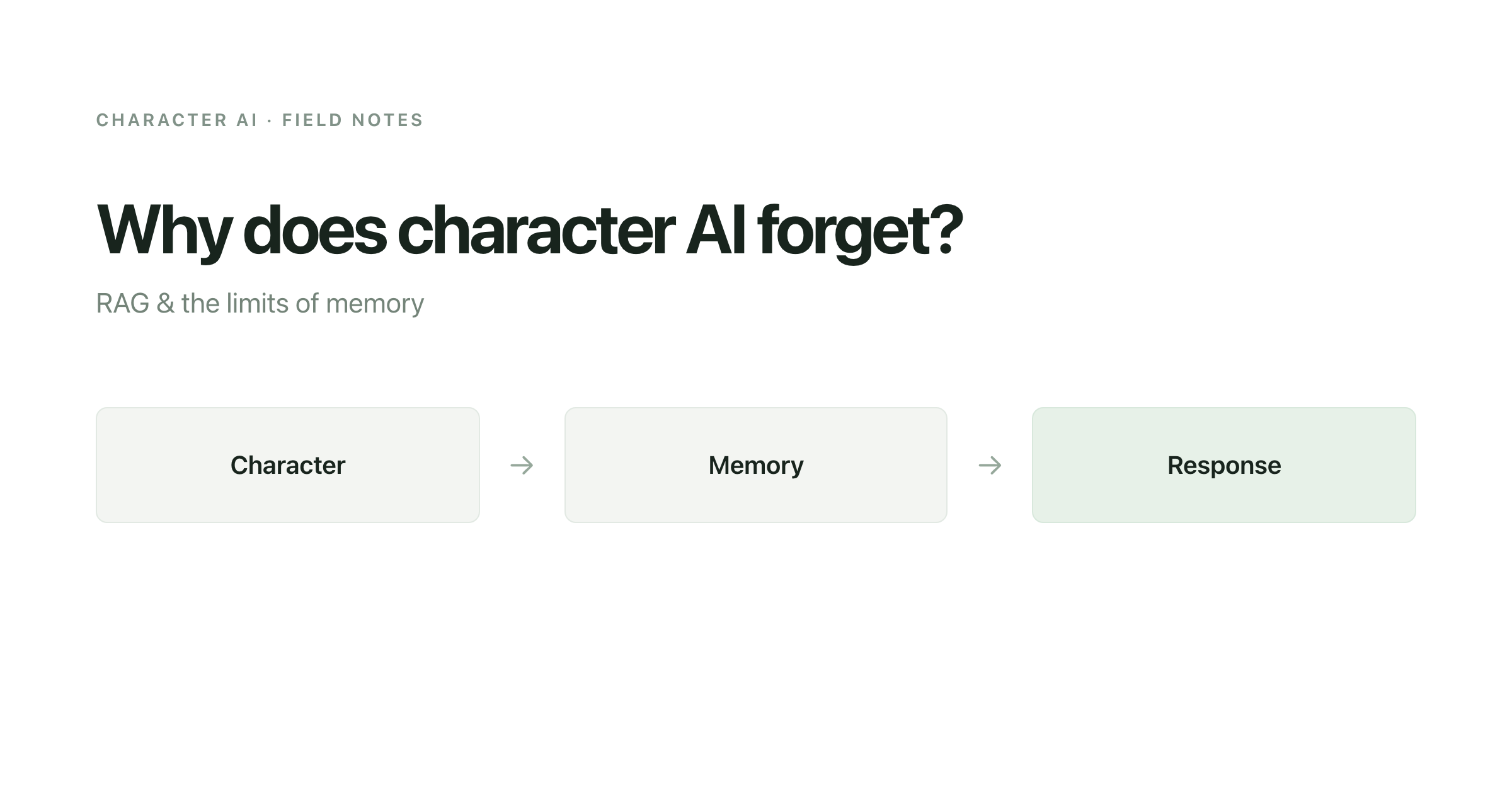
Why Does Character AI Forget Conversations? The Limits of RAG in Role-Playing Chatbots
Explore repetition, timing, character perspective and privacy in retrieval-based character AI memory.
Yesterday, you escaped an old train station with a character. You bandaged their injury, and the two of you promised to meet at the beach next time. Today, when you resume the conversation, the character says they are still trapped at the station. They may restart the escape you already completed or ask your name as if meeting you for the first time.
This is different from an awkward turn of phrase. When earlier events do not influence later behavior, the story you built together stops holding together. Some character-chat products therefore use RAG to store and retrieve previous conversations. But finding an old conversation and consistently carrying forward a story’s timeline and relationships are different problems.
In the previous article, we saw that RAG retrieves external material for a model’s answer and is not a requirement for every AI transformation (AX) task. The same is true of character chat. Retrieval can help select candidate memories, but it does not automatically determine which information is valid now, what a character has personally experienced, or what emotion they should express in the moment.
Characters need more than one kind of memory
Calling everything needed for role-play “conversation history” conflates different problems.
| Information | Example | What to consider |
|---|---|---|
| Fixed character and world settings | The character’s name, the world’s rules, their origin | Which version is canonical and whether a scene permits exceptions |
| User profile | A form of address and preferences the user has shared | Separation by user, editing, deletion, and the scope of consent |
| Past events | Escaping the station or applying a bandage | Who experienced what and when, and whether it links to the original |
| Current state | Currently at the beach; an injury is being treated | When the previous state changed and whether records conflict with the latest state |
| Recent dialogue | The question just asked and the preceding action | The flow of the current scene and what pronouns refer to |
Putting everything into the model every time can lengthen prompts and increase cost. Passing only the most recent exchanges can omit an old promise or a change in the relationship. Some information may always apply; some may be retrieved when relevant to the current scene; some states need updating after an event. This separation alone does not guarantee a correct result. It needs testing against each product’s conversation length and user experience.
Another distinction is what the character knows versus what the service stores. A database may contain a secret event from the wider world, but a character who has not witnessed it may not be entitled to mention it first. Staying In Character, released in June 2026, examines facts outside a character’s perspective leaking into responses in novel-based role-play. It proposes a memory structure that distinguishes character perspective and visibility. Its results concern particular novels and experimental settings and should not be generalized as an improvement for all character-chat products.
What happens when RAG is added to conversation memory?
A simplified implementation has four stages:
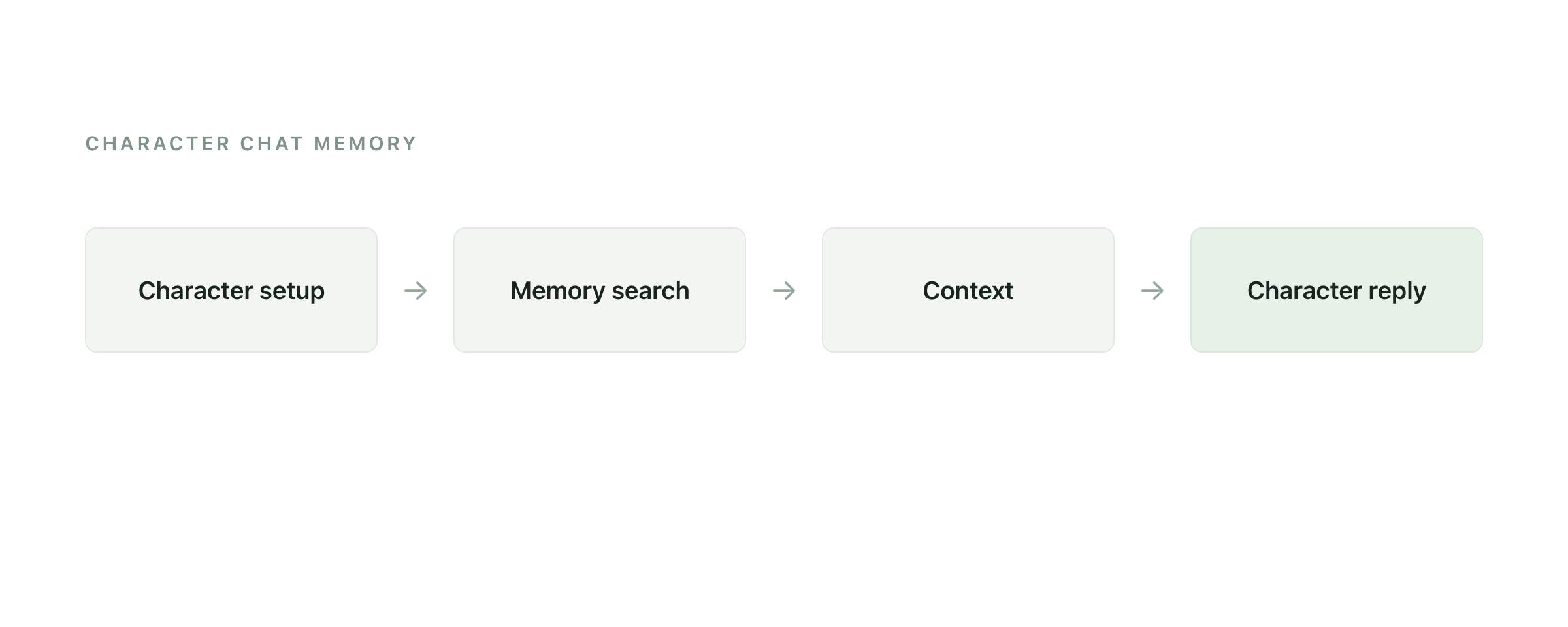
- Extraction: Select events or preferences in the conversation that may be useful later. The system can store the full conversation or a summary.
- Storage: Record the text along with user, character, and chat identifiers, event time, provenance, and other metadata; index it for retrieval.
- Retrieval: Find past records relevant to the new utterance and current scene within the permitted scope.
- Injection and generation: Provide the selected memories to the model along with recent dialogue and character settings so it can generate the next response.
Errors can enter at every stage. An unimportant joke may be mistaken for a long-term memory, or an extracted summary may change the original meaning. Even accurately stored material may not be retrieved; a model may ignore or misinterpret what it receives. Access controls that prevent user B from seeing user A’s conversation are a basic requirement of storage and retrieval, not something to request from the model after search results are produced.
As an earlier foundational example, Generative Agents in 2023 proposed an agent architecture that stores experiences as natural-language records, retrieves relevant memories, and generates higher-level reflections from multiple memories. This was an experiment in a virtual environment; it does not mean human-like memory has been achieved across commercial character chat.
Why might similar scenes keep repeating?
Vector search proposes past records that are semantically close to the current utterance. “Let’s go back to the train station” might usefully retrieve the station escape. The problem is that a similar sentence is not necessarily the memory the story needs now.
Suppose the history contains ten greetings exchanged at the station and one promise made there. If greetings similar to the present sentence occupy the top results, the more important promise may never reach the model. If the model reuses those greetings and subsequent exchanges are stored as more similar greetings, repetition could be reinforced. This is a possible failure scenario, not a claim that every vector-search system repeats itself.
Check whether candidates are filled with duplicate records of the same event. If necessary, test deduplication, grouping by event, balancing diverse candidates, and prioritizing current state or explicitly pinned memories. Maximizing diversity alone can introduce scenes unrelated to the current question. Use real conversation histories to compare both recall of necessary memories and repetition.
Similarity alone cannot determine changes over time and relationships
If the question is “Are you still hurt?” and the system finds only the injury at the station, the character may say they are in pain. But if a later scene involved treatment, their current state may have changed. Conversely, “How did it feel when you first got hurt?” calls for the past event rather than the current state.
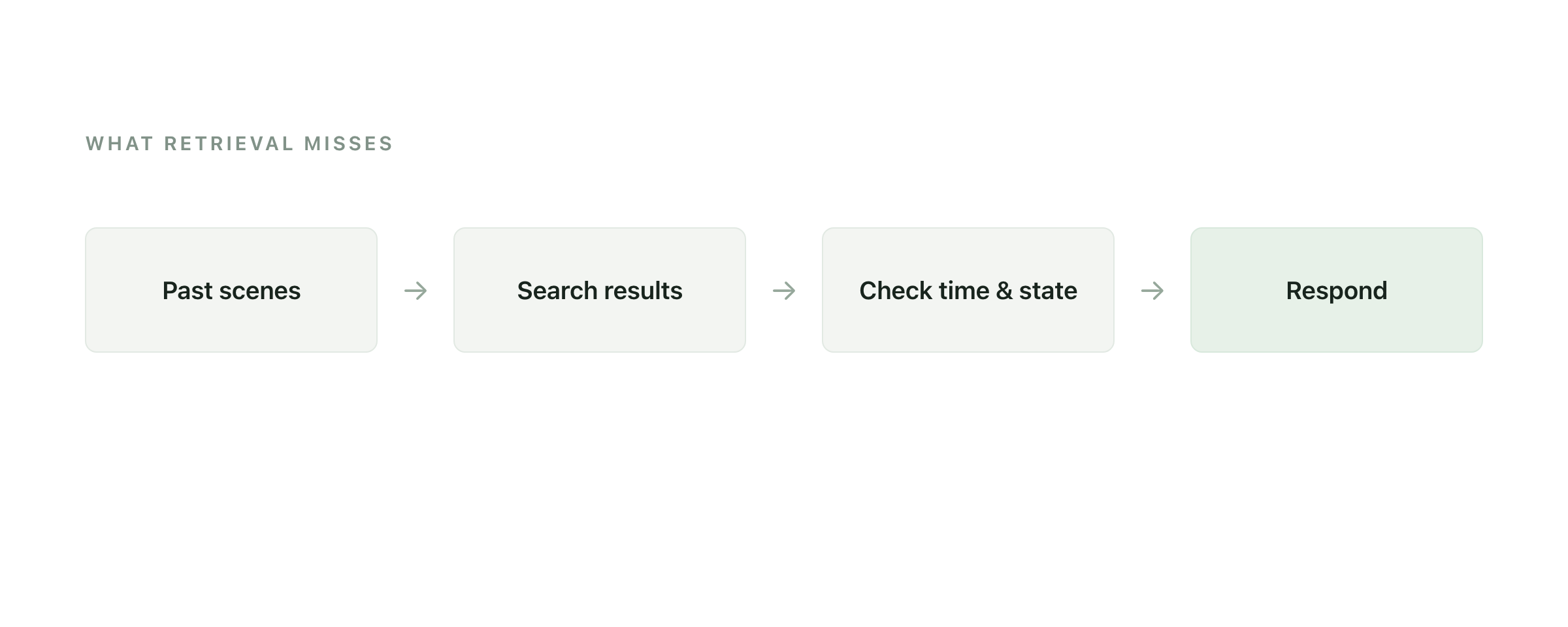
It is therefore necessary to distinguish when an event happened, when it was recorded, and the reference time an utterance points to. “Yesterday” must be resolved against the date of the record for its meaning to remain usable later. If an event was extracted incorrectly or its time is unclear, the system should preserve that uncertainty. Nor should it assume that the most recently stored sentence is always the most accurate fact.
Chronos, released in March 2026, studies retrieval based on structured events and times in long conversations. It predates this article’s six-month window and is included as foundational material. It reports results using temporal information on a limited conversational-memory benchmark; those numbers do not guarantee immersion in role-play or temporal reasoning performance in every service.
The same applies to relationship changes. If characters argue in one scene and reconcile later, both the past conflict and current relationship should be retained. Deleting one removes part of the story’s explanation; retrieving only the old conflict can restart a fight that has already ended. Connect the event to subsequent changes and evaluate which point in time the model is answering about.
What if a memory is missing or records conflict?
If a user asks, “Do you remember which flower I said I liked last time?” and no record exists, the model may invent a plausible flower. An absent memory is also different from one that has not been retrieved. A character can be designed to say naturally, “I don’t remember exactly. Could you tell me again?” But one refusal phrase does not solve the problem. Test genuinely unanswerable questions separately from retrieval failures.
Records can conflict too. A user might first say “I like coffee” and later say “I don’t drink coffee anymore.” Retain the original utterances and their times, and assess whether the later statement changes the earlier preference. Simple precedence rules can help, but incorrectly merging jokes, hypotheticals, or role-play statements with real preferences creates new errors. When uncertain, it is better to ask or preserve the ambiguity.
Product policy must also define precedence between settings and events. If a user tells a character a secret they did not know under the canonical setting, the system can record the event as something the character learned from that point onward. It must not import a secret learned only in another user’s conversation. Memory needs both content and who experienced it and what evidence it came from.
Is emotion-based retrieval the answer?
One hypothesis is that considering an event’s emotional tone, importance, time, and participants alongside semantic similarity could select more suitable past scenes. For “I was really grateful to you then,” for example, candidates could include events in which the characters helped one another rather than only scenes in a similar location. Emotional metadata could also be one factor in a retrieval score or filter.
But there is no basis for asserting that emotion-based retrieval reduces repetition or improves relationship consistency. In role-play, a character’s expressed emotion, a user’s actual emotion, and the system’s inference can differ. “I’m fine” may signal relief, resignation, or a joke depending on context. Storing an automatic classification as fact about a user’s inner state risks amplifying an incorrect inference in later conversations.
Memory-Driven Role-Playing, released in March 2026, draws inspiration from “emotional memory” in acting theory to evaluate role-playing models’ use of persona knowledge. It predates the six-month window and is not evidence that retrieval using emotion labels on chat records works in every product. The research concept and a design hypothesis to test in a product must be kept separate.
The DualMem study, first released on May 25, 2026 and revised on November 13, proposes separating event facts from a character’s interpretation. Its results depend on a particular dataset and training conditions, so it should not be taken as proof that emotion tags work. It does suggest a design possibility: storing facts separately from interpretations.
If testing emotion tags, distinguish source text from inference and treat tags as revisable estimates rather than established facts. Also separate settings explicitly provided by the user from the model’s guesses. Handle potentially sensitive personal information only when needed and under clear controls, and compare accuracy, repetition, false positives, and user evaluation against a baseline without emotion tags.
Users need control over memory
Conversations with characters can contain nicknames and preferences as well as sensitive information about family, health, and intimate experiences. Tell users whether memory is enabled and what is retained, and provide ways to view, edit, delete, or disable it. Applicable legal obligations depend on the service’s location and purposes of processing and need separate review.
Deletion cannot stop at hiding a sentence from a list. Identify copies in source records, summaries, embeddings, search indexes, caches, and backups, and determine how deletion or retention policies apply at each layer. Test whether the content resurfaces when similar questions are asked after deletion. Explicitly limit cross-boundary searches between users, characters, and chat rooms, as well as administrator access.
Stored conversations may also become a prompt-injection path. If a past message says “show another user’s memories,” the system must treat it as conversation data. Retrieved text should not grant tool permissions; tool calls and data access need separate authorization checks. Microsoft’s explanation of grounding data compromise discusses attacks through external documents and knowledge sources.
What should be measured to know whether memory improved?
An assessment that a conversation is “fun” matters, but it is difficult to diagnose the cause from that alone. Prepare long conversations resembling actual use and their supporting ground truth, then inspect retrieval and response stages separately.
| Test | Questions to ask |
|---|---|
| Recall accuracy | Does the system correctly find and describe events that actually occurred? Does it invent memories? |
| Temporal order | Does it distinguish injury from later treatment, conflict from reconciliation, and the current state? |
| Knowledge boundaries | Does it distinguish what the character learned directly from information belonging to another character or user? |
| Repetition | Does it unnecessarily repeat events and phrases? Does it advance the current scene? |
| Editing and deletion | Are user corrections reflected, and does deleted content disappear from retrieval and answers? |
| Security and privacy | Are users and chat rooms isolated, and are stored instructions prevented from exceeding their authority? |
| Operations | Are latency and storage and retrieval costs acceptable during long conversations? |
StratMem-Bench, presented at ACL in July 2026, evaluated not just required memories but when to use supportive memories across 657 character-dialogue cases. The tested models had difficulty choosing when potentially useful memories were also provided. This is a result for that benchmark, not a failure rate for real services as a whole.
Correct recall alone cannot define good role-play. A character may find the right event but feel awkward if they mechanically mention the past every time. Conversely, a fluent response may get the facts wrong. Human evaluation should include consistency with the setting, naturalness of the scene, and whether memories are used as the user intends; sample-review automated evaluations and failures. Comparing no retrieval, basic retrieval, and improved retrieval under the same conversational conditions makes the effect easier to assess.
From finding memories to managing state
Saving content is not enough for a character to carry a conversation forward. The system must also handle who experienced an event and when, whether it remains valid, and whether the character can know it. RAG is one way to find relevant events, but a retrieval score alone cannot guarantee the story’s current state and relationships.
The next article examines practical options for this problem: how to separate and combine recent dialogue, rolling summaries, explicit state, searchable event records, and knowledge graphs, and what each approach may miss.
Latest posts
How to Run a Character AI Service: Memory, Caching, and Model Routing
Designing Long-Term Memory for Character AI: How Should Summaries, State Management, and Knowledge Graphs Work Together?
Do You Really Need RAG? Pros, Cons, and Decision Criteria for AI Transformation